
Country: Argentina
Organisation Name: The Halal Catering Argentina (HCB)
Founded in the Year: 1962
Position: Co-Director & Head of International Relations Department
Website: www.theHalalcateringargentina.com
Personal Introduction:
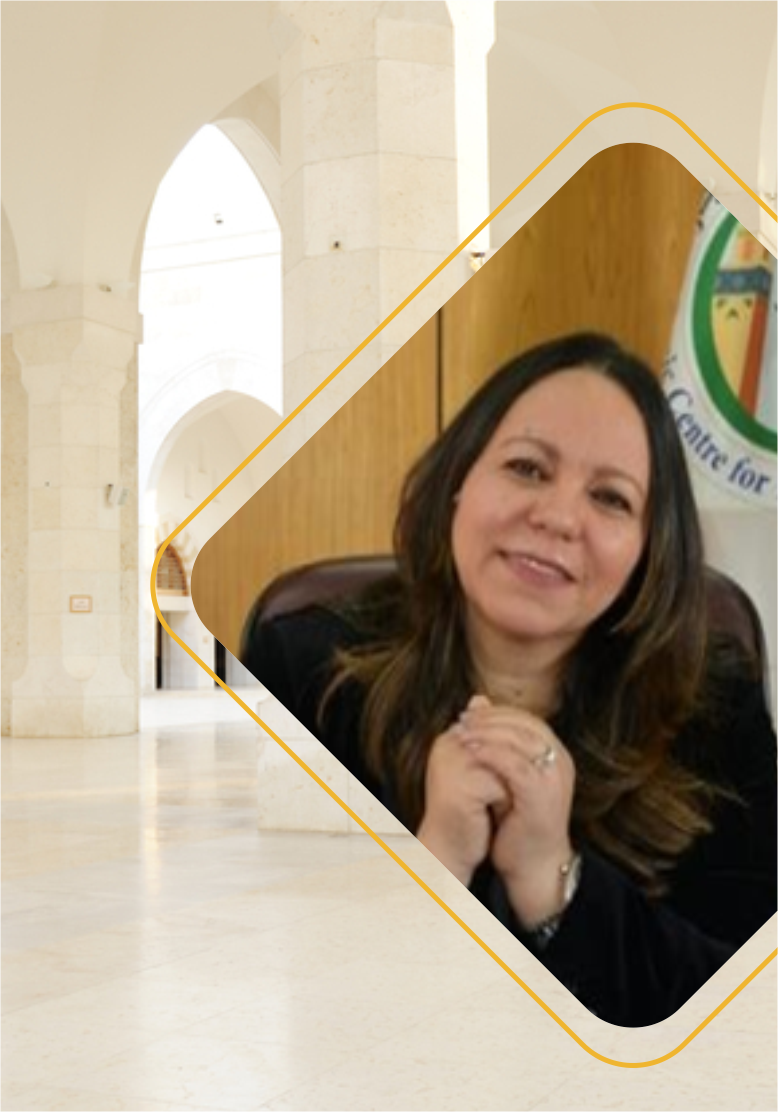
She is Co-Director of The Halal Catering Argentina (HCB) and Head of the International Relations Department at THCA, with a professional career deeply rooted in the development and internationalization of the Halal industry.
Her activism and commitment to Halal have led Melody Amal Khalil Kabalan to participate in diverse international forums and global platforms, where she has actively promoted the Argentine Halal model, as well as the institutional and professional experience of THCA and HCB, positioning Argentina as a relevant actor within the global Halal economy.
She served as Vice President of the Islam Institute for Peace, becoming the first woman in Argentina to preside over an Islamic institution between 2020 and 2025,
She holds a specialization in Conflict Resolution from the University of Maryland (United States) and graduated in 2022 from the King Abdullah bin Abdulaziz International Center for Interfaith and Intercultural Dialogue (KAICIID) as part of the Latin America Cohort Scholarship Program.
She currently serves as Co-Chair of the International Abrahamic Forum, becoming the first Muslim woman to hold this position, with the organization based in Germany.
She is a member of the World Halal Council behalf The Halal Catering Argentina HCB.
Additionally, she is a member of the Religions for Peace Youth Committee for Latin America and the Caribbean and serves as Representative for Latin America and the Caribbean on the Commission for Gender Equality within Religions for Peace.
Her professional trajectory, combined with her engagement in interfaith dialogue, peace-building, and the Halal industry, positions her as a qualified and relevant contributor to this book, which seeks to honor Muslim women who actively contribute to the global Halal economy through leadership, entrepreneurship, and ethical commitment.
Her commitment to dialogue, fraternity, and peace from an Islamic perspective has led her to receive international recognition, including the distinction of Woman of Excellence awarded by Religions for Peace International.
Professional Introduction:
Regarding the field of Halal certification, I work in the area of international relations, convinced that the professional Islamic community must work together for any contribution and development that is desired, in this case, to what concerns us at THCA, that food Argentine products and supplies comply with the Islamic regulations determined in each country of destination. I have just committed to work together with the public organizations of my country, private companies and promotion agents to meet the importers who need their demand to comply with the Islamic Shariah and the accreditation entities.
Interview Questions:
What inspired you to start your career in the Halal industry?
What inspired the creation of THCA HCB was a concrete need: the Islamic community in Argentina did not have sufficient access to Halal products within the country, despite possessing high-quality raw materials capable of serving global markets. At the same time, many countries were seeking Halal products from Argentina, as the country offers essential resources and food products required worldwide.
Within this context, and supported by the recognition of the Islamic community, strong community leadership, and extensive work with embassies across the Arab and Muslim world, my grandfather was requested by embassies and religious leaders from various countries: including Kingdom of Saudi Arabia to take responsibility for safeguarding and developing Halal standards.
Thus began, several decades ago, what later evolved through the incorporation of my father: Gustavo Khalil into The Halal Catering Argentina (HCB).
On a personal level, my inspiration comes from the history, conduct, and commitment of my ancestors to Halal. It has always been a family endeavor and a core part of my identity. I felt called to continue this legacy, but from my own perspective: connecting people, strengthening trust, and ensuring reliable Halal certification from a remote country with a Muslim minority, to the broader Islamic world.
I am also inspired not only by the present, but by the future. Protecting Halal in accordance with the teachings of the Holy Qur’an through the principle of Khalifat al-Arḍ (stewardship of the Earth) learning from one another, and understanding that unless we unite as one family, the Halal ecosystem will continue to face challenges and shortcomings, have all been central to my motivation.
This vision has led THCA HCB to consolidate its role as a mediator between Argentine production and high-quality products that meet the requirements and demands of the global Halal market.
Today, our certifying body supports hundreds of Argentine companies, ensuring their products serve the life of Muslims around the world as Halal certified goods. These products transcend borders not only geographical, but also cultural and ethnic ones. Halal unites the world.
What were the challenges you had to overcome in the initial stages of starting your initiatives?
The challenges have been many, though the rewards have been even greater. One of the main challenges is geographical distance compared to other countries. Argentina is often described as “the end of the world,” which can increase costs and limit opportunities to attend international Halal forums and trade fairs.
Nevertheless, consistent effort and strong conviction have demonstrated that despite this distance and even if not all Muslim consumers know our faces, the Halal market continues to trust and choose us as responsible custodians of Halal compliance.
On a personal level, one of my earliest challenges was traveling alone to foreign countries. My first destination was Saudi Arabia, many many years ago, at a time when far fewer women were active in this industry than today.
This reality is not rooted in Islamic principles, as Islamic history has always presented us with exemplary female role models. Among them is Khadijah bint Khuwaylid (r.a.), the first wife of the Prophet Muhammad (peace and blessings be upon him), whom one could today compare to a CEO/ leader of the Quraysh trade caravans. Her economic leadership, together with that of Sahaba Abu Bakr (r.a.), played a fundamental role in enabling Islam to reach distant lands, with Indonesia now being the country with the largest Muslim population.
Likewise, the personality of ‘Aisha (r.a.), who preserved and transmitted a significant portion of the Prophetic hadith, reflects the intellectual capacity, resilience, and strength of women within Islam.
When I compare these historical precedents with we as women of Halal industry experience, I recognize that although I am young, during my early years of study and professional work, women’s participation in this industry was far more limited than it is today.
My generation stands at the intersection of a profound structural transformation, marking a significant shift toward greater inclusion and leadership of women within the Halal ecosystem.
What is the most important thing you feel anyone needs to do to build a successful career in the Islamic Economy?
Professionalism, camaraderie, commitment, order, responsibility and faith. We can talk about many steps and acts to take into account but above all there is something that we cannot forget, what we do is in the name of Islam and each act and action must be clean of all kinds of corruption. We have a very high commitment, which is to safeguard Halal.
What were the most important learning experiences you would like to share?
I learned that we are a great Halal family and that despite speaking different languages, eating different dishes, dressing differently, living more than 15 or 41 hours away by plane, we have the same goal. Protect Halal, learn from each other and as long as we don’t come together as one family, Halal will continue to have faults and mistakes on our part. Today more than ever we must take care and protect the Halal of so many organizations that use the name of Islam solely for personal economic benefit without even safeguarding the certification steps and their procedures. I learned that it is necessary to work as a global team, as we are doing with this book and surely the next works, InshaaAllah.
What advice would you give aspiring leaders in the Islamic Economy?
While it is sometimes difficult to get involved as a practitioner of Islam, especially in the West, it is even worth the challenge. We know that contributing to an Islamic economy that we can translate as an equitable, just, peaceful economy with opportunities has many benefits: one is in this passing world for a more stable way of living and the other is the benefit of “akhira” eternal life and having fulfilled the Command of the Creator.