
Country: Malaysia
Most Significant Contribution/Involvement in Islamic Economy:
Setting up conducive environments in Halal educational ecosystems, encouraging diverse team players to join forces in terms of expertise, infrastructure and sufficient facilities, research special interest groups, steering committees and educational syllabus that meet the needs of industry, government, and society through cross-disciplinary collaboration were some of the duties done. A solid network and innovative educational partners and services were created through a Halal research centre in a government supported Islamic university, as a centre of research excellence that brings researchers from different faculties, and international links, are mobilizedto do research and innovation on broad scholarly topics in questioning the status of halal, haram, shubhah and istihalah.
Started in the Year: 1997
Significant Position(s):
- Chairperson for the Malaysian Quality Assurance Halal Studies program standards for the Malaysian Education system which describe syllabus from levels, such as certificate, diploma, degree, Master and PhD.(2019-2020)
- The working committee in setting up the Halal Action Laboratory for College Genius Insan (2013-2014)
- Founding Director for IHRAM (Institute of Halal Research and Management) Universiti Sains Islam Malaysia (2010-2014)
- Steering Committee team members that the Graduate School of Muamalat for Master program in Halal Products-2008 and Bachelor of Syariah in Halal Industry for Faculty of Syariah and Law, USIM- 2014
- Early career lecturer (2006-2009) Deputy Dean for Faculty of Science and Technology, (USIM)
- Working committee to set up IHRAM – (2004-2008)
- Committee member for INFAD (institute of world fatwa council) USIM sub-committee for the halal industry
- Graduate research assistant in a local university for halal and improved nutritional content, via food product development researches, in stearin and palm fats to substitute animal fats used in processed meats (1995-2002)
Website: usim.academia.edu/AlinaAbdulRahim
Personal Introduction
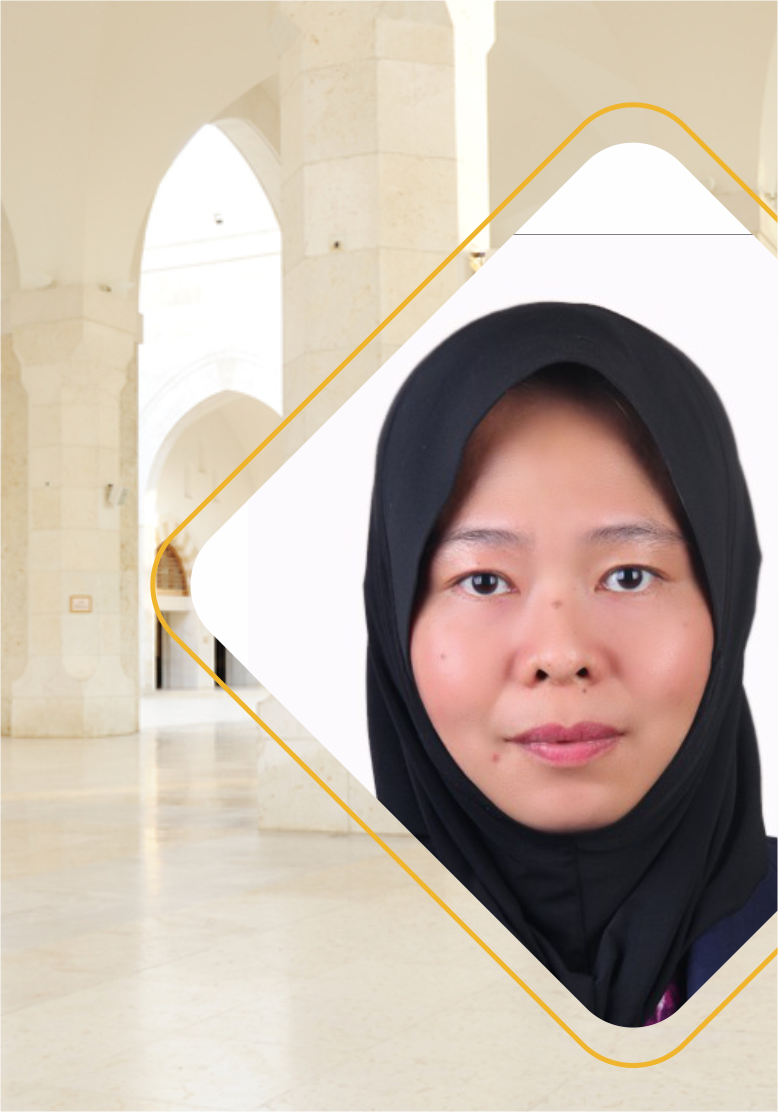
Ms Alina loves food, and healthy living, thus her interest to pursue a career in food science and nutrition. Being surrounded by students, throughout her career, the principal aim is to produce future talents in youths. This is done through knowledge sharing, mentorship, and encouragements of activities to uphold the sanctity of Halal, through food, products, and services.
When the physical being is healthy, clean and pure, oneself can be strengthened and consistently become a servant of Allah swt, uphold the teachings of the Prophet Muhammad s.a.w, and be of service to self, families, friends, communities and nations, for the betterment of humanity, prevent fraud, negligence and maximize the use of science and technology as tools to solve problems. Halal is not discriminatory for Muslims only, but for the benefits of mankind.
Professional Introduction
Currently serving as a lecturer in the Food Biotechnology Program, at Universiti Sains Islam Malaysia (USIM), Associate professor Dr. Alina Abdul Rahim received her Ph.D in Food and Nutrition Technology at the National Universiti of Malaysia or Universiti Kebangsaan Malaysia (UKM) in 2004. Professional and voluntary Halal projects were focused within the university, in Malaysia, and internationally.
Involvements included various steering and working committees; Member of the (INFAD-Institut Fatwa Sedunia) (World Fatwa Management and Research Board), Panel for Halal Industry, Member of the Board of Studies: Halal Industry Program external auditor for Masters and Ph.D. in Science and Social Sciences at the International Islamic University of Malaysia (IIUM), Member of the Malaysian Society of Animal Production. (MSAP, 2005-2006), Malaysian Oil Science Technology Association (MOSTA, 2000-2003) and Malaysia Institute of Food Technologists (MIFT, 1997-2006). As the first founding director of IHRAM, or Halal Research Institute and Halal Management Center of Research Excellence at USIM, various national and international Halal training projects, including Laboratory Professional hands-on workshop programs were established, including the ISO17025 Molecular analysis for lab testing in determining halal, haram, and Syubhah status, for food and consumer goods under the Bionexus Laboratory partnership initiatives by Biotech Corporation, Malaysia.
She was involved in the JAKIM committee volunteer (2012-2014) in building the early drafts for Halal food training modules, and had been appointed to the JAKIM Fatwa Research Panel sector for the Halal Industry. From the years of 2015 to 2016, she was appointed as an advisory scientist at Technology Park Malaysia for the Laboratory in Halal Science, in a project that involved being a technical coordinator for the Joint China Ministry of Science Technology (MOST) and Malaysia Ministry of Science Technology (MOSTI) Halal Laboratories for Gansu Province. As a liaison officer, between varsities, a joint Halal International Management Conference was successfully organized by USIM and Sejong Cyber University, held in Seoul, R.O. Korea in 2017. Editorial tasks included the writing of several book chapters, a book on nutrition, and food articles related to science, halal, and nutrition in indexed international and local journals, manuscript reviewer for several International Journals such as the International Food Research Journal, the International Journal of Food Sciences and Nutrition and Food Chemistry, and as an editor to one Indonesian University for a Halal Online journal. In 2008 and 2021, she worked with a team of manuscript writers to draft Halal training modules for Halal Development Corporation HDC Malaysia for certificates and NOSS (National occupational skills standards) modules. She was an assistant coordinator for International Relations, for the Faculty of Science and Technology, USIM, connecting people and helping them to achieve success in Halal projects is inspirational and meaningful. She was appointed as one of the panel judges for an international iHalal award, under the patronage of H.E. Mr. İhsan ÖVÜT, the Secretary-General of SMIIC for Global excellence in the Halal industry. Launched in Dec 2020, an education standard manual for Halal studies, under the MQA (Malaysian Quality Assurance), Ministry of Higher Education, mandatory in the Malaysian tertiary and higher education, was developed by a team of Halal experts from Syariah, industries, education and government agencies, with her, as the chairperson for the working committee. Involvement in setting up new Halal academic programmes such as Master in Muamalat for Halal Product for the Faculty of Economy and Muamalat, USIM and the Bachelor Program of Halal Industry, of the Faculty of Shariah and Law, USIM, may contribute to the future professional working force for the country. As a Fellow for the Industrial Biotechnology Center of Excellence, Universiti Malaysia Pahang, figuring out how to have sustainable Halal ingredients and raw materials, from nature, in a sustainable manner, remains a challenge. Being part of the committee member for the Food Composition Database initiatives working group, for the Ministry of Health, Malaysia, helps provide insights that food should not merely be Halal, but also to be Toyyib, and wholesome.
Interview Questions:
What inspired you to start your career in the Halal food sector?
It was unplanned and accidental. When I started my career as a lecturer, majoring in Food Science, our Dean, of the Faculty of Science and Technology, that as among one of the pioneering lecturer that started a new Science faculty, one must not be choosy, and teach all students, from the backgrounds of science, humanities and Islamic Studies. The working culture is such that, knowledge, involving theory, practical, science, technology, and applied sciences, was made mandatory, to be integrated with the Al-Quran, Sunnah and Hadith from the Prophet Rasulullah SAW, in the academic syllabus. Setting up a Halal Science teaching and services labs, also allow new opportunities to learn and share the know-hows, from other more established Halal Research Centres at that time, especially from the late founding director of Halal Research Product Institute, Universiti Putra Malaysia, (Almarhum Prof Dr Yaakob Che Man) and many scientists friends from International Halal Research and Training (INHART, IIUM) International Islamic Universiti of Malaysia.
| The value proposition of Halal is to provide integrity, honesty, and safe products that serve the basic human rights of goodness, achieving safe and good quality products and services is made realistic, through the help of quality and safety assurance systems. |
In championing the Halal causes, Asian culture is tolerant and blends well with other non-Muslim multiracial ethnics, thus setting a benchmark of conduciveness benefitting the Halal industry, as consumers, and manufacturers, enjoy innovations and improvements of consumer products and services.
What were the challenges you had to overcome in the initial stages of starting your career?
Halal norms in culture and practice were taken for granted, in certain areas of vulnerabilities; in the olden days, until the end of the 1990s, when trust had to be relied only on word of mouth, with a lack of formal or structured systems, measurements, and traceability in place. It is ironic to consider that, Halal finally became mainstream, for the lucrative profits it brings to the manufacturers and producers. The value proposition of Halal is to provide integrity, honesty, and safe products that serve the basic human rights of goodness, achieving safe and good quality products and services is made realistic, through the help of quality and safety assurance systems. Changing the mindsets of those who are unmotivated or uninitiated about the benefits of Halal, is a challenge.
What is the most important thing you feel anyone needs to do to build a successful career in the Halal Economy?
Believe, and live Halal. Barakah blessings will come, immediately, and in the hereafter.
What were the most important learning experiences you would like to share?
Through patience, continuous education and accurate updated information and Halal knowledge, obstacles can be overcome.
| Sharing is caring, irrespective of colour and creed. The beauty and appreciation of teamwork, made the challenges, troubles and satisfaction, worth it. |
Halal is for all. Sharing is caring, irrespective of colour and creed. The beauty and appreciation of teamwork, made the challenges, troubles and satisfaction, worth it.
What advice would you give aspiring leaders in the Islamic Economy?
Strive for the highest quality, and not just remain happy with the minimal requirements for the sake of acquiring Halal certification. Create sustainable Halal Jobs for all, for wealth, share prosperity, well-being, and world peace.